
Common types of room temperature air coolers and heaters on the market
Article source: Faq Responsible Editor: Guangdong Hepai New Energy Technology Co., Ltd. Publication time:2025-08-27
Analysis of Common Types of Room Temperature Heating and Cooling Machines
1. Classified by technical principles
Compression type cooling and heating machine
Variable frequency vortex type: adopting full DC variable frequency technology, the energy efficiency ratio (APF) can reach 5.28, supporting wide temperature operation from -25 ℃ to 55 ℃, representative models such as Gree Yunjia series
Variable frequency centrifugal: suitable for large space commercial scenarios, with a cooling capacity of 30-200kW, commonly used in data centers and large shopping malls
Heat pump type cooling and heating machine
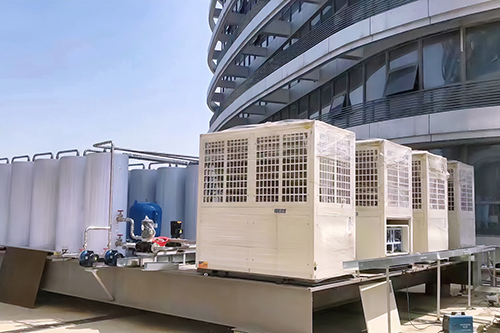
Air source heat pump: equipped with jet enthalpy increasing technology, the COP remains above 3.0 in low-temperature environments, such as the Hualing N8HE1 Pro
Ground source heat pump: Heat is exchanged through an underground constant temperature layer, with an energy efficiency ratio of 4.5-5.0, but a pre embedded pipeline system is required
2. Classified by structural form
①. Wall mounted: 1-1.5 horsepower, silent design (≤ 18dB)
②. Cabinet type: 3 horsepower or more, circulating air volume ≥ 1300m ³/h
③. Mobile all-in-one machine: No installation required, integrated humidification function
④ Special function models
Fresh air cooling and heating machine
Equipped with an independent fresh air module (such as AUX MA11 series), with an hourly air exchange capacity of 40m ³ and a PM2.5 filtration efficiency of ≥ 99%
Bathroom and residential dual-use machine
Integrated waterproof design and warm air mode, such as Gree NBFC-X6021, supporting three levels of temperature adjustment
⑤. Select key indicators
Energy efficiency level: Priority should be given to selecting models with a new level of energy efficiency (APF ≥ 5.0)
Temperature control accuracy: The temperature difference fluctuation of the frequency converter model can be controlled within ± 0.5 ℃
Low temperature performance: It needs to be confirmed whether electric auxiliary heating is configured for environments below -25 ℃

 WhatsApp
 TIKTOK