
Working principle of heat pump water heater
Article source: Company News Responsible Editor: Guangdong Hepai New Energy Technology Co., Ltd. Publication time:2025-08-27
Detailed explanation of the working principle of heat pump water heater
一、Core work cycle
The heat pump water heater achieves heat transfer through reverse Carnot cycle, which mainly includes four key processes:
1、Evaporative heat absorption
Low temperature liquid refrigerants (such as R32) absorb heat from air/water sources in the evaporator and evaporate into low-temperature gas. This process can lower the evaporator temperature to 6.5 ℃, creating a significant temperature difference with the environment.
2、Compression heating
The compressor compresses low-temperature gaseous refrigerant into high-temperature and high-pressure gas (with a temperature of up to 80-120 ℃), which consumes electricity but has an energy efficiency ratio (COP) of 3-5.
3、Condensation releases heat
High temperature refrigerant exchanges heat with water in the condenser, releasing heat to heat the water tank (increasing temperature by 40-60 ℃). The refrigerant condenses itself into a high-pressure liquid.
4、Throttling and pressure reduction
The liquid refrigerant returns to the evaporator after being depressurized by the electronic expansion valve, completing the cycle.
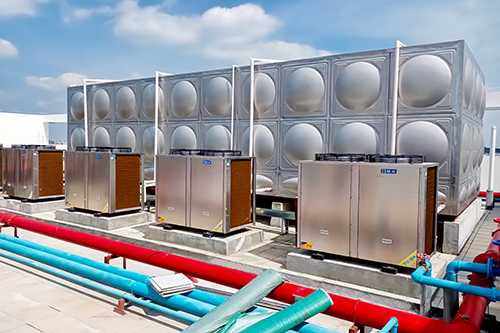
二、Key component functions
1. Compressor, function: provide driving pressure and increase refrigerant temperature
2. Condenser, function: exchange heat with water, release heat to heat the water tank
3. Electronic expansion valve, function: precise control of refrigerant flow and pressure
三、Energy efficiency characteristics
COP value: Under standard operating conditions, it can reach 4.0-5.0 (i.e. 1 degree of electricity can transport 4-5 degrees of heat)
Low temperature impact: Electric assisted heating may be activated below -7 ℃, resulting in a decrease of about 30% in efficiency
Defrosting mechanism: Regular defrosting is required in high humidity environments, which affects 5-10% of the operating time
- Knowledge and market demand of air source water heaters
- Main characteristics of air source water heater
- Is the operating cost of electricity for air source heat pump water heater units high?
- How does a low altitude air source heat pump water heater unit heat water to 65 ℃ when the air temperature is low?
- What kind of device is Hepai's air source heat pump water heater unit?
- What is the difference between an air source water heater and a regular electric water heater
- Application scenarios of heat pump heating machine
- Working principle of heat pump water heater
- Common faults and solutions of heat pump water heaters

 WhatsApp
 TIKTOK